Home / Products / ThromboLedger
Live demo · pilots open
From the notebook on your desk to the evidence FDA will ask for.
ThromboLedger is an R&D workspace for medical device inventors who still think on paper. Photograph a notebook page and it becomes a reviewed, fingerprinted document. The mechanism, bench results, risks, spending and the FDA evidence list stay linked in one history you can hand to an engineer, a regulatory consultant or an investor. Configured first for neurovascular thrombectomy devices.
Founding physician pilot: 3 places · gap map in 14 days or the second half is waived
The invention is on paper. The evidence has to be somewhere else.
Physician inventors do the hard part by hand: sketches, bench observations, the reasoning behind each change. The trouble starts when that work has to become something an engineer can build from, a reviewer can trace, or an investor can fund. Pages get retyped, numbers drift, and nobody can say which version of the idea a test result belongs to.
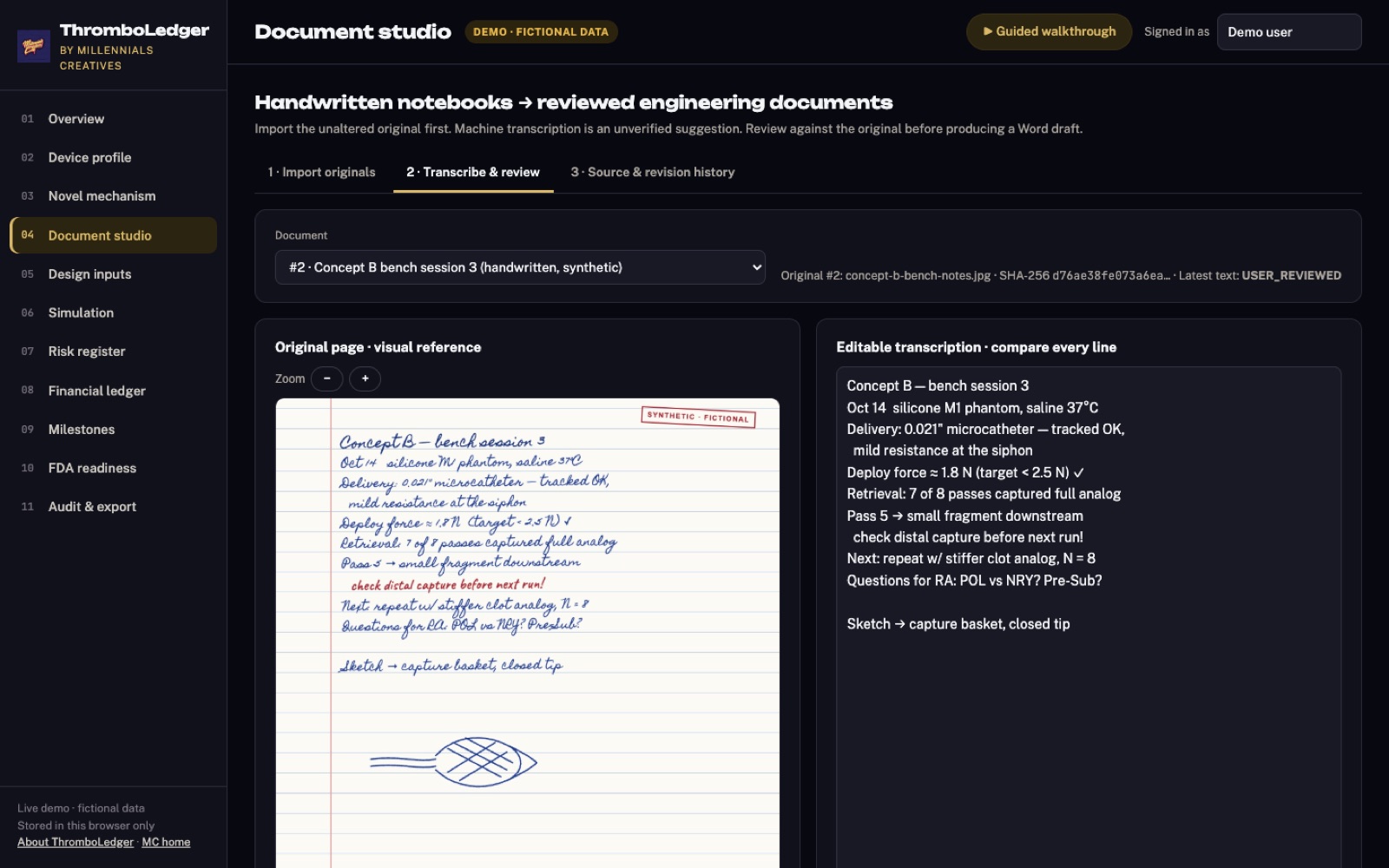
ThromboLedger keeps the original page untouched and fingerprinted, puts a typed draft next to it, and only counts the text once a person has checked it line by line. From there the same record carries forward: the mechanism revision it describes, the requirement it turns into, the protocol that tests it, the risk it controls and the FDA evidence item it answers.
Anything still unknown stays visibly unknown. The software never fills a gap with a guess, never predicts clinical results, and never submits anything to FDA.
Six problems that fall between the tools you'd otherwise buy.
Sources: OpenRegulatory eQMS pricing, SimplerQMS pricing, consultant hourly rates, LabArchives handwriting extraction. Checked October 2026. Not legal advice.
What exists, and what ThromboLedger adds.
ThromboLedger is for the years before you need a validated quality system. When you do need one, your records export to it.
| Paper + consultants | Lab notebook (ELN) | eQMS platform | ThromboLedger | |
|---|---|---|---|---|
| Starts from your handwritten pages | Yes, but they stay on paper | Images, some read handwriting | Scanned PDFs | Typed beside the fingerprinted original |
| A person signs off before text counts | No | No | Document approvals | Every page, before export |
| Notebook typed for you | No | No | Document migration | Your backlog, done for you |
| Requirements, risks and tests linked | By hand | Not built for it | Yes | Yes |
| Refuses a test plan that can't reach its target | No | No | Not found | At approval |
| Inventorship record for counsel | Bound notebooks | Dated entries | Not its job | Revisions, contributors, fingerprints |
| FDA evidence gap map with next moves | Consultant hours | No | Templates and checklists | Read from your own work |
| Budget and runway | Spreadsheet | No | No | Double-entry, built in |
| Time to first value | Weeks | Days | Weeks of onboarding | 2 business days |
| Typical cost | $150–$450/hr | Varies | About $12k–$45k a year | Free test, pilot $15,000 |
A working session, start to finish.
The live app walks through every step below on a fictional project, with a button to do each one for you.
- Capture the pagePhotograph or scan the notebook. The original is fingerprinted on arrival and never edited.
- Review the transcriptionTyped draft beside the original. Fix what the machine misread, sign off, export a Word document with its provenance.
- Update the mechanismEach change is a new revision. Open questions about materials, failure modes and testing stay on the list.
- Plan and record the bench workRequirements, pass rules fixed before testing, results scored automatically, and an honest confidence bound on what the runs support.
- Control risk and costHazards closed only against evidence. Spending in balanced books, with runway from what was actually spent.
- Prepare the FDA conversation27 evidence items, including neurovascular and novel-device questions, each closed only with a pointer to the proof.
- Hand it overVerify the history hasn't been altered, then export one package for advisers, with a fingerprint manifest.
Built around how inventors actually work.
The Founding Physician Pilot: your notebooks to an evidence map in 90 days.
Three places, because each pilot works directly with our build team. We do the heavy lifting. Your part is photographing pages and signing off.
$7,500 to start. The second $7,500 only when your gap map arrives and earns it (see the guarantees).
- Your notebook backlog, typed for youUp to 300 pages transcribed by our team and laid out beside the originals for your sign-off, in the first 30 days.
- Configured to your deviceMechanism fields, requirements, test plans, risks and all 27 FDA evidence items set up for your device class, under a mutual NDA before you describe anything.
- Your evidence gap map in 14 daysEvery item: what you already have, what's missing, and the next move. You bring this to a regulatory consultant instead of paying them to find it.
- Inventorship record with independent timestampsEvery revision and contributor, fingerprinted and dated by a trusted third-party time-stamping service, ready for your patent attorney or tech-transfer office.
- Secure setupWindows or web, encrypted storage, an account for each person, and a backup we prove can be restored.
- A monthly evidence review30 minutes with the build team, plus a fresh adviser package before every consultant, engineer or investor meeting.
The guarantees
We guarantee our work, never an FDA decision. Classification, testing and submission strategy stay with qualified regulatory professionals.
What this replaces
After the pilot
3 pages typed for your review within 2 business days, with an error report.
Send 3 pages90 days, 3 places. Everything above. The fee is credited to year one if you continue within 30 days.
Claim a placeOr $24,000 a year, saving $6,000. Up to 60 pages a month typed for you, a live gap map, monthly evidence review, timestamped inventorship records. Founding pilots keep their year-one price for two years.
Ask about StudioSeveral devices or a team: individual accounts for engineers and consultants, custom deployment, a dedicated build contact.
Talk to usAll fees in US dollars, billed by invoice under a signed agreement. Final scope and dates are confirmed in a statement of work.
A software studio that ships and runs its own products.
ThromboLedger is built by Millennials Creatives, the same team that designs, ships and operates these:
Our founding team includes a legal nurse consultant, and our medical advisory board convenes in January 2027.
ThromboLedger organizes development records. It is not a validated quality-management system, not 21 CFR Part 11 certified, not an eSTAR form, and it never submits anything to FDA. It does not simulate clot removal or predict safety or efficacy, and its checklists are planning prompts, not regulatory advice. Classification, testing and submission strategy belong with qualified regulatory and quality professionals. Everything in the live app is fictional; don't enter patient information.
See it run on your own notes.
Send three pages you don't mind sharing. In two business days you'll see exactly what happens to them. Free.
Build questions: finesse@millennialscreatives.com · Partnerships: jeff@millennialscreatives.com